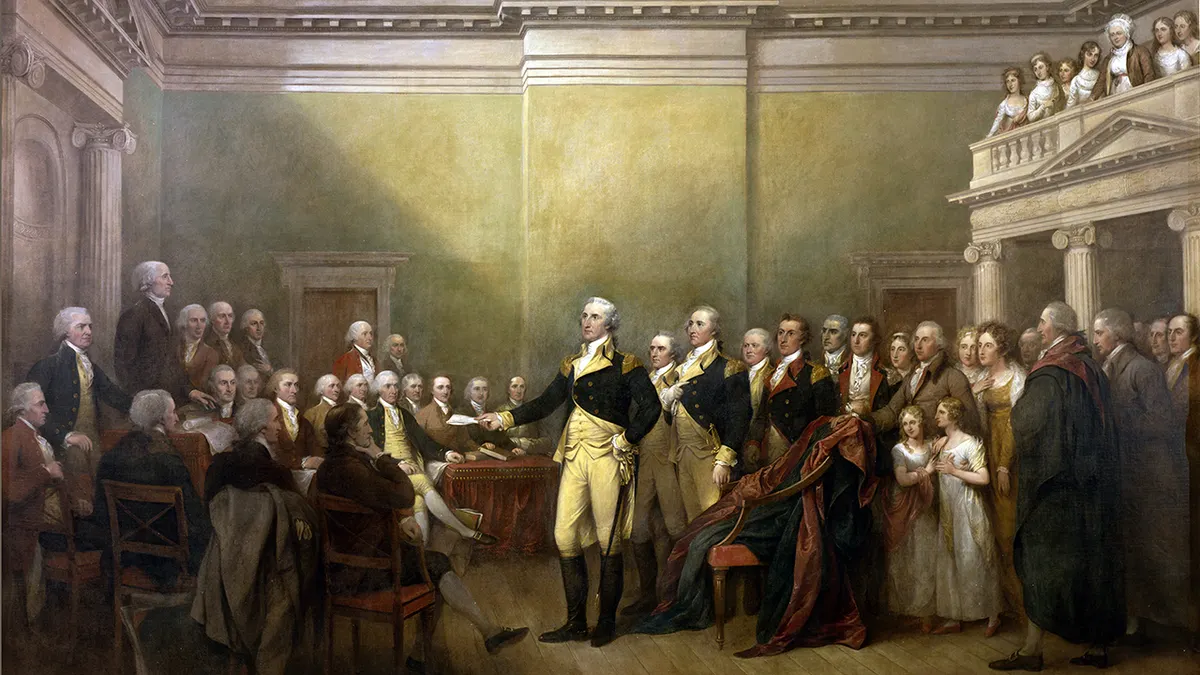
The Election of 1792 saw George Washington become the first two-term President in American history. Although Washington’s victory was certain, the contest for the vice presidency revealed the rise of partisan divisions between Federalists and Democratic-Republicans — a political split that would shape the nation’s future.
Background
By 1792, the United States had grown beyond the original 13 states. Vermont (admitted March 1791) and Kentucky (admitted June 1792) joined the Union, while North Carolina and Rhode Island, which had refused to participate in 1788, had now ratified the Constitution. For the first time, the election was held with every state represented.
Washington, reluctant to continue in office, was persuaded to serve a second term for the sake of national unity. His popularity made the presidency uncontested. Instead, attention turned to the vice presidency — and to the growing partisan divisions that had emerged since the first election.
The Rise of Partisan Divisions
In the Election of 1788, politics largely split between Federalists, who supported the new Constitution, and Anti-Federalists, who resisted it. By 1792, those labels had evolved into clearer party identities.
- Federalists, led by Treasury Secretary Alexander Hamilton, favoured a strong central government, assumption of state debts, creation of a national bank, and policies designed to encourage commerce and industry. Supporters included Vice President John Adams and Chief Justice John Jay.
- Democratic-Republicans, led by Secretary of State Thomas Jefferson and former Federalist James Madison, opposed Hamilton’s program, arguing for states’ rights, limited executive power, and an agrarian-based society. They also sympathised with Revolutionary France, while Federalists urged caution.
Though Washington himself avoided party affiliation, his policies aligned closely with Hamilton’s Federalist vision. The seeds of America’s two-party system were now firmly planted.
The Vice Presidential Contest
Since Washington’s re-election was guaranteed, the real battle of 1792 was over the vice presidency.
- John Adams – The incumbent Vice President, representing Federalist stability and continuity.
- George Clinton – Governor of New York and a long-time critic of centralised government, backed by Democratic-Republicans.
- Thomas Jefferson – Though interested in higher office, he was effectively sidelined, as the Constitution prevented electors from choosing both a president and vice president from the same state (he and Washington were both Virginians).
- Aaron Burr – A young, ambitious senator from New York, he represented a new generation of Democratic-Republicans and received scattered support.
Voter Participation
The number of electoral votes had nearly doubled from 69 in 1788 to 132 in 1792, reflecting the Union’s expansion.
Voting practices, however, remained inconsistent:
- In states such as Maryland and Pennsylvania, electors were chosen by popular vote.
- In others, like New Jersey and South Carolina, state legislatures appointed electors directly.
Property requirements restricted suffrage, meaning only a fraction of white men could vote, and turnout varied widely. While the process was broader than in 1788, early U.S. democracy remained highly exclusive.
The Results
The outcome confirmed Washington’s unrivalled status:
- George Washington – 132 electoral votes (unanimous)
- John Adams – 77 electoral votes
- George Clinton – 50 electoral votes
- Thomas Jefferson – 4 electoral votes
- Aaron Burr – 1 electoral vote
Washington became the first U.S. president to serve two terms and remains the only president ever unanimously re-elected.
Regionally, Adams dominated New England, where Federalist policies found strong support, while Clinton carried parts of the South and mid-Atlantic, reflecting Democratic-Republican strength. These voting patterns foreshadowed the geographic divide that would define many future elections.
Significance
The Election of 1792 cemented Washington’s leadership while foreshadowing the growing intensity of partisan conflict. His second term would be dominated by disputes over:
- Foreign policy — especially neutrality in the French Revolutionary Wars.
- Domestic policy — particularly Hamilton’s financial program and Jefferson’s opposition.
- The growing rivalry between Federalists and Democratic-Republicans, despite Washington’s repeated warnings against factionalism.
This election also marked the last uncontested presidential race in U.S. history. From 1796 onward, presidential contests would become openly competitive, bitter, and deeply partisan.
Legacy
The Election of 1792 built directly upon the Election of 1788, which had first installed Washington and revealed flaws in the electoral system. Together, these contests confirmed his unmatched popularity but also exposed the inevitability of party politics in the new republic.
Next came the Election of 1796, the first true party contest in American history, where Washington’s absence forced the nation to choose between Adams and Jefferson in a struggle that would reshape the presidency. These tensions would only intensify, culminating in the dramatic Election of 1800, remembered as America’s first peaceful transfer of power between rival parties.
Leave a Reply